
Opinion or Reality? Does Customer Experience really make a difference?
Please allow me to remind you of the following company names:
Woolworths; Comet; Land of Leather; Borders; JJB Sports; Zavvi; HMV; MFI; Jessops; Focus DIY; Habitat; Threshers; Dreams; Clinton Cards; Peacocks; Past Times; Barratts; Phones4U; TJ Hughes; Ethel Austin; Oddbins; Adams (childrenswear); Allied Carpets; I could go on…… and bear in mind that I am only quoting names of UK companies who have either entered administration or ceased to exist altogether in the last seven years.
Yes these failures occurred during a financial crisis. However, the crisis only served to push companies over the edge – companies who were already teetering at the top of a cliff. In almost all cases, these brands had lost touch with the evolving needs of their customers and the world around them. Failing to adapt their propositions resulted in customers voting with their feet – the predominant reason why a business ultimately will cease to exist.
Companies struggle to survive on a regular basis – again this is largely down to the fact that their product, service or experience is no longer aligned to the needs of their customers. Look at Nokia, Kodak, Radio Shack – this is not just a UK phenomena.
In fact I would like to remind you of the most clear cut example of all – JC Penney. In 2011, as the new CEO of one of the largest department stores in the US, Ron Johnson (once of Apple) made a number of strategic decisions without the benefit of either employee or customer insight. Johnson decided to change the established logo, change the pricing policy (including the halting of sales and the elimination of coupons). He also changed the layout of the stores. A very traditional business with an extremely loyal customer base, the decisions were catastrophic. This is an excerpt from his profile on Wikipedia:
Many initiatives that made the Apple Store successful, for instance the “thought that people would show up in stores because they were fun places to hang out, and that they would buy things listed at full-but-fair price” did not work for the J.C. Penney brand and ended up alienating its aging customers who were used to heavy discounting. By eliminating the thrill of pursuing markdowns, the “fair and square every day” pricing strategy disenfranchised JC Penney’s traditional customer base.Johnson himself was said “to have a disdain for JC Penney’s traditional customer base. When shoppers weren’t reacting positively to the disappearance of coupons and sales, Johnson didn’t blame the new policies. Instead, he offered the assessment that customers needed to be “educated” as to how the new pricing strategy worked. He also likened the coupons beloved by so many core shoppers as drugs that customers needed to be weaned off.”
By the time he was fired in 2013, JC Penney had lost over $4 billion during Johnson’s tenure. Having fired him, they launched a nationwide TV advertising campaign apologising to customers and ‘begging’ them to come back.
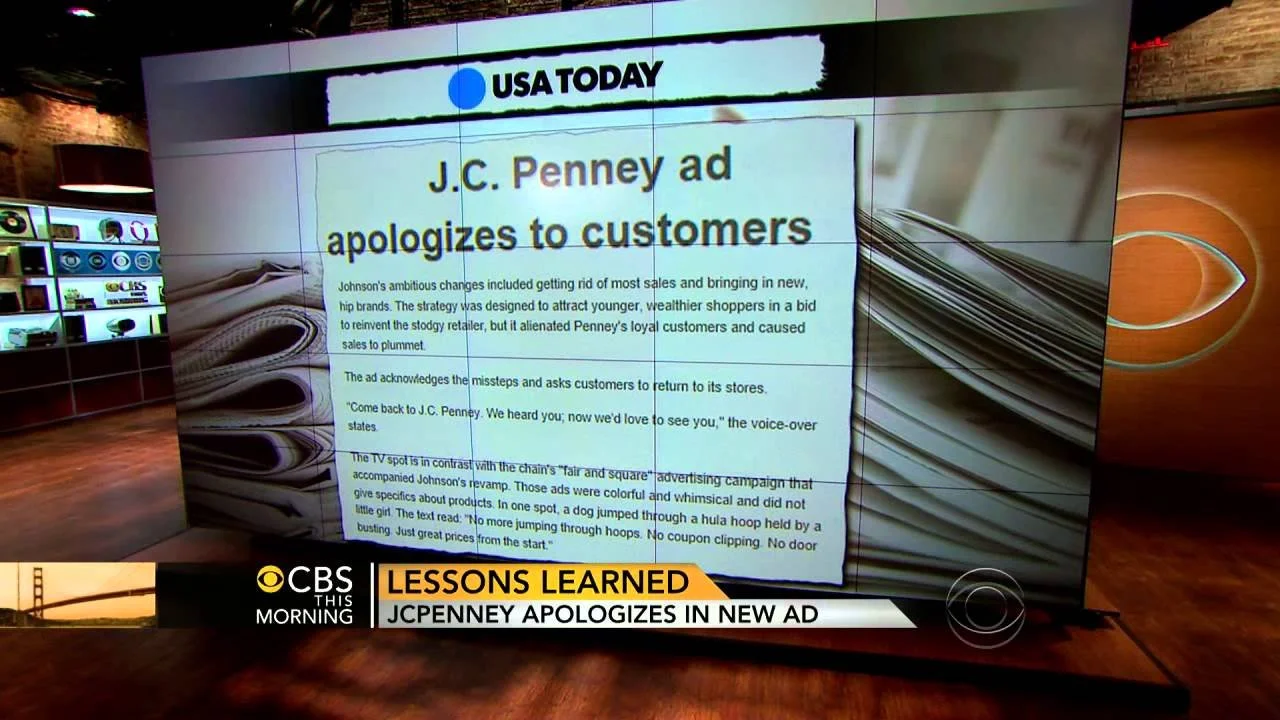
This is the reality of what could happen if you do not listen to your customers or employees. Just because a company still exists, it does not mean it successful at delivering consistently good customer experiences. The challenge is for business to achieve sustainable growth – all good things come to an end eventually if you do not remain focused on both commercial goals AND customer needs. You can read more about the JC Penney story in this Forbes article.
The reality is that nothing lasts forever. Organisations thrive, whilst others struggle. Businesses cease to exist on a daily basis. The larger the organisation, the more unlikely it is to fail altogether - but it is not impossible. As we have seen with the likes of Tesco and Marks and Spencer in recent times - failure to continually adapt your proposition to align to the changing needs of your customers will likely result in financial struggle.
The reality is that even already financially prosperous companies have realised how important the Customer Experience is to their future sustainability. I have had a number of conversations with board members of very large UK companies since January - these are companies whose financial fortunes have IMPROVED consistently since 2008. However these companies have openly acknowledged that unless they put the Customer Experience at the top of their priorities NOW, the future will not be as rosy.
This is not opinion. This is fact. This is reality. Does Customer Experience really make a difference? I will leave it for you to form your own opinion.